Skills, Commands, Sub-agents... It's All the Same Thing Now!
Claude Code used to give us a neat little taxonomy:
- Commands: quick, explicit “saved prompt” shortcuts (
/test→ runs a prompt). - Skills: richer procedural knowledge packs that the model could auto-discover based on intent.
- Sub-agents: “personas” that worked in a forked context so your main conversation stayed clean.
It was tidy. It was elegant. It was… doomed.
Condensed mini-blog from my piece on how Claude Code’s recent updates collapsed 3 abstractions into 1 (and why that’s fine)
The old world: three lanes, no overlap
Back then, the decision was pretty straightforward:
- Want a shortcut you manually trigger? Command.
- Want a reusable procedure the model can find and apply? Skill.
- Want an “expert worker” persona that runs separately? Sub-agent.
You could actually draw a decision tree and not hate yourself.
The update that broke everyone’s mental model
Then the recent Claude Code updates arrived and casually knocked down the fences:
1) Skills can be invoked like Commands
Skills aren’t only “auto-discovered” anymore. You can now explicitly run a Skill with a slash, just like a Command.
That erases one of the main functional differences.
2) Skills can fork context like Sub-agents
Skills also gained a YAML front matter option called:
Meaning a Skill can run in its own independent context window — the signature move of sub-agents.
So now:
- A Skill can act like a Command (explicit invocation)
- A Skill can act like a Sub-agent (forked context)
- A Sub-agent is basically a prompt that can load Skills
At some point you stop asking “which abstraction is correct?” and start asking “are we just naming the same thing three times?”
A mental model that still works
When implementation details blur, the only way to stay sane is to categorize by intent, not mechanics.
Skills = Knowledge Packs (SOPs)
Treat Skills like Standard Operating Procedures — reusable capabilities and step libraries.
Use a Skill when you have something like:
- a specific script/workflow (e.g., “parse a PDF and extract tables”),
- a checklist (e.g., “code review steps”),
- a repeatable procedure that should exist independently of any persona.
Practical tip: model your Skill as a folder:
- SKILL.md
- any resources it needs (snippets, templates, helper files)
Sub-agents = Personas (Workers)
Sub-agents are the identity layer — conceptual knowledge, role, worldview.
Use a Sub-agent when you want:
- “Security Engineer” energy for a review,
- “QA Tester” behavior to drive a test run,
- an agent that should work in a contained context (especially useful when it goes off exploring).
The composition: tools + workers
The punchline is simple:
Skills are the tools. Sub-agents are the workers who wield them.
Build a “Code Reviewer” sub-agent that loads: - a “Security Review” Skill - a “Style Guide” Skill
Then let that persona execute in a forked context while your main workspace stays uncluttered.
Wrap-up: the vocabulary is messy, your architecture doesn’t have to be
Claude Code’s feature set is in a transition period: powerful, flexible, and a little linguistically chaotic. The old “choose Command vs Skill vs Sub-agent” decision trees don’t apply anymore because Skills absorbed everyone’s superpowers.
So instead:
- Organize by purpose: procedures go in Skills, identities go in Sub-agents.
- Compose: load Skills into Sub-agents like tools into a toolkit.
- Use context forking intentionally: keep exploratory or noisy work in a separate window.
Try it: take one workflow you already use, refactor it into a Skill (procedure) plus a Sub-agent (persona) that loads it. Your future self will thank you — quietly, from a cleaner context window.
📖 Read the Full Article
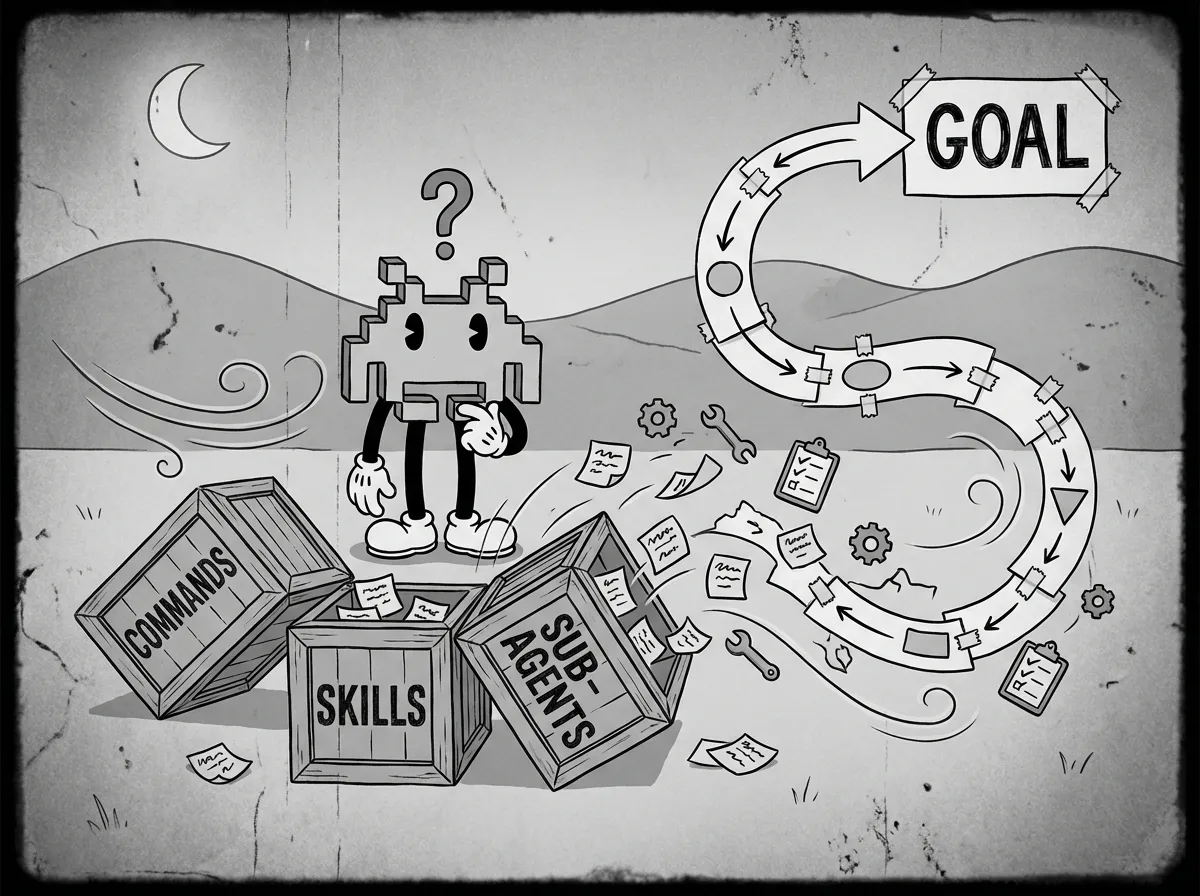
Skills, Commands, Sub-Agents... it's all the same thing now!
How Claude Code's recent updates collapsed three abstractions into one (and why that's fine).
📖 Full article available on Substack